
Lillianes in the Aosta Valley: the church of San Rocco Photo: stock.adobe.com/Alessandro
From our editorial team
Lots of meat, lots of cheese, cabbage and turnips - pizza and pasta don't really exist here. This mountainous region in the north is a paradise for hearty food. Our series: This is how delicious Italy eats. Today: the Aosta Valley.
There is no such thing as one Italian cuisine. Italy has 20 regions - and each region has its own specialities (read more). We taste them all. Nice and bite-sized and in small bites. We start in the region that has nothing to do with pizza and pasta. In the mountains, it's hearty. Today:
- This is the Aosta Valley
- Mountain worlds: This is how the Aosta Valley eats
- The export hits
- Buon Appetito! Typical meals
- The most unusual speciality: cow udders
- In vino veritas: cin-cin!
- Tasting and shopping on site
Welcome to Valle d'Aosta
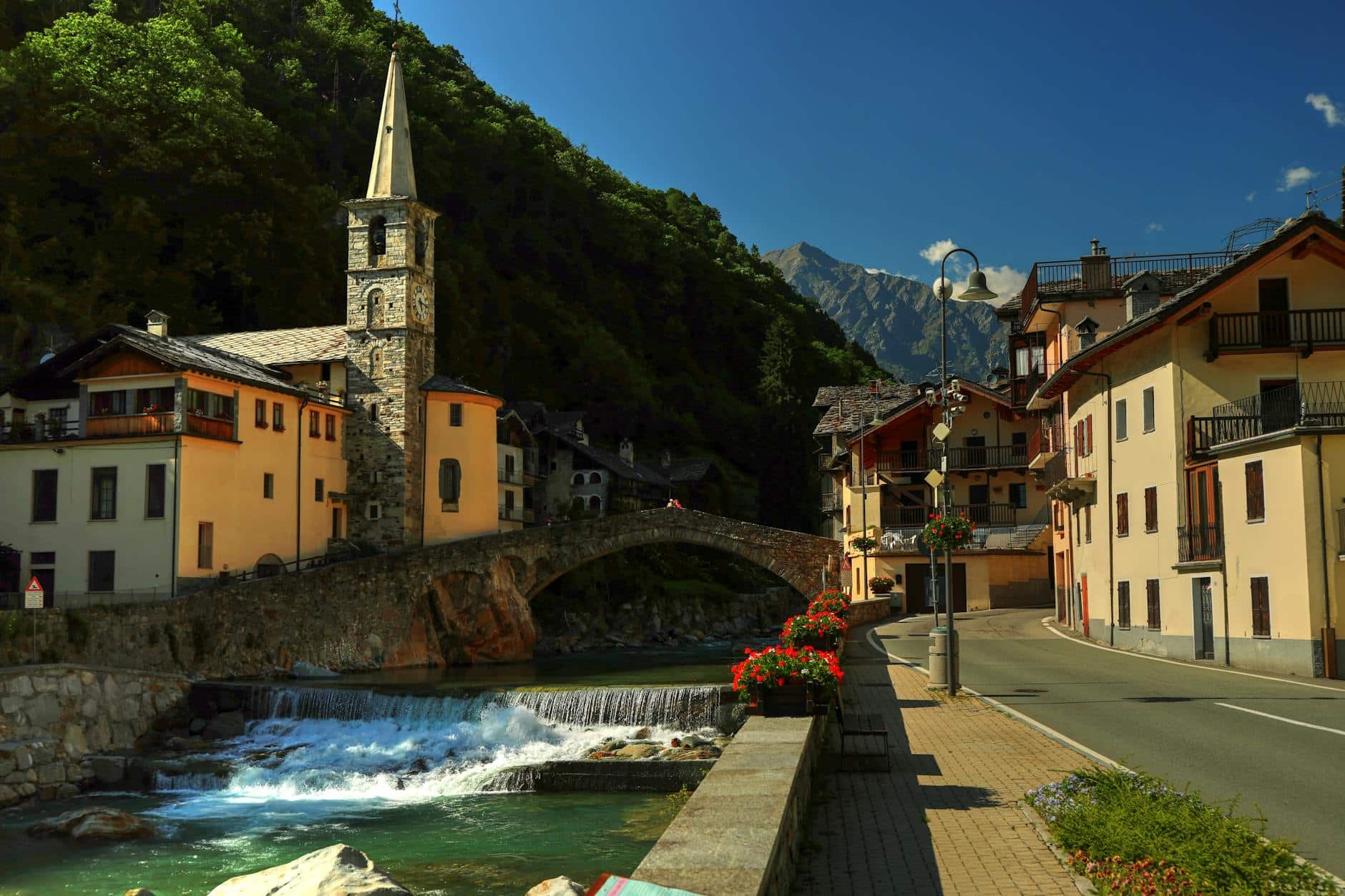
Photo by Gildo Cancelli on Pexels.com
The Aosta Valley is located in the mountains in north-west Italy, on the border with France to the west and the French-speaking part of Italy to the south.en Switzerland to the north. The valley borders Piedmont to the south and east. The The official languages are Italian and French. With the exception of the capital of the Aosta/Aoste region, all municipalities have French names.
The area is the smallest region in Italy ("regions" are effectively the federal states, more here). Only about 125,000 people live on a good 3,200 km². It is bordered by Mont Blanc in the west and Monte Rosa in the north.

The highest density of gourmet temples
A small corner on the border with France, up in the mountains in the north-west - with culinary repercussions for the whole country. There are 16 Michelin-starred restaurants in this small region alone. No other region has a comparable density of Michelin-starred restaurants. There is one gourmet temple for every 7,800 locals. In comparison: in Lombardy, there is one Michelin-starred restaurant for every 29,500 people.
Italian everyday rituals that make life better
Mountain Worlds: This is how the Aosta Valley eats
The traditional cuisine of the Valle d'Aosta is strong and hearty. A peasant cuisine, shaped by life in the Alps.
For centuries, the mountains determined what went on the table - and that was locally grown produce: Typical meals to this day are made of cereals, (black) bread, cabbage, savoy cabbage, cheese, bacon and chestnuts. Due to the high altitude, tomatoes and olives played no role for lack of cultivation possibilities.
The region is famous for its cheeses. Fondue made from Fontina, the star among the local cheeses, is widespread here.
From trattoria to pizzeria: Italy's restaurant types
Export hit from the Aosta Valley
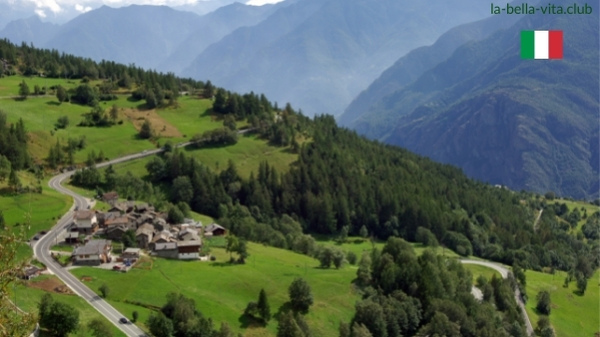
Photo: Arsty/Getty Images via canva.com
The designation DOP means "Denominazione d'Origine Protetta", the Italian seal for products with a protected designation of origin.
Cheese & butter
- Beuro de brossa: a particularly creamy butter with mountain meadow aroma. The butter is made with Brossa, a fatty substance from cheese processing.
- Fontina DOP: a semi-cooked cow's milk cheese that has been made since the 13th century. The cheese is salted and brushed in a rock for three months, at a humidity of up to 90 per cent.
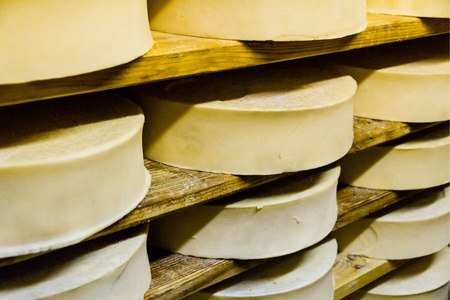
Photo: Orietta Gaspari/Getty Images Signature via canva.com
- Fromadzo DOP: a semi-hard semi-hard cheese made from skimmed cow's milk, known since ancient times, first mentioned in writing in the 15th century. The milk comes from two milkings, sometimes goat's milk or herbs are added.
- Saras or Seirass del fen: a spicy ricotta that has been produced since the 13th century - once a delicacy for the nobility. The special feature: the long maturing in hay. In the past, the ricotta was transported to the valley from shelter in the hay, which gave it its special taste. The ricotta tastes pleasantly sour and spicy.
The villages have a great effect when hiking
Meat & Sausage

Screenshot: Instagram/@nacko_milano
- Boudin: a blood sausage made from potatoes, diced bacon, beetroot, beef and pork blood, herbs and spices. For a long time a staple food in the mountains. Eaten hot and cold.
- Jambon de Bosses DOP: a raw ham with the aromas of mountain herbs, produced exclusively in the commune of Saint-Rhémy-en-Bosses at 1,600 metres. It must be matured for at least one year.
- Motzetta: Air-dried sausage made from beef, chamois, venison or wild boar. It is marinated in herbs and salt for 20 days and then dried for one to three months. A tried and tested method to preserve the meat for a long time. Sliced wafer-thin, it becomes a tender morsel. Also known as mocetta or motsetta.
You are currently viewing a placeholder content from YouTube. To access the actual content, click the button below. Please note that doing so will share data with third-party providers.
More InformationThe pork fat festival is always held in the municipality of Arnad on the last weekend in August
- Lardo d'Arnad DOPcured pork bacon, which is produced exclusively in the municipality of Arnad in the lower Aosta Valley. The pieces of bacon are cured in a brine flavoured with juniper, bay leaf, nutmeg, sage and rosemary - and have been for more than two centuries in wooden tubs made of chestnut, oak or larch.

Screenshot: Instagram/@cuori1strada
Toast
- Genepy: a LiqueurIt is obtained from the alpine herb Genepy (lat. Artemisia) or Wehrmut, with a yellow-green colour and an intense plant scent. The taste is warming and slightly bitter.
- GrappaA pomace spirit (at least 37.5 percent). It is distilled from the fermented alcoholic press residues of wine production, the pomace.
From nature
- on offer: chestnut honey, dandelion honey, lime honey, mountain blossom honey or honeydew honey
- Apples (Renette or Golden Delicious), pears, nuts, mushrooms and chestnuts
Baked goods

Photo: Quanthem/Getty Images via canva.com
- Shingles (Tegole): Biscuits made from hazelnuts, sugar, egg whites, flour, sometimes with almonds or vanilla.
- Miasse: savoury rectangular waffles filled with cheese (salignön)
- "Cani di quartiere": Italy's street dogs with official toleration
- Italy and the Etruscans: A forgotten civilisation and its heritage
Meal time! Dishes in Valle d'Aosta
You can feast - restraint and counting calories won't get you far in the mountains of the Aosta Valley.
This stew has bang!
The "Seupa à la Vapelenentse", the "Valpellinoise soup" gave the poor mountain people the energy they needed for their hard work. The stew consists of fontina cheese, dried bread, savoy cabbage, meat broth, butter and cinnamon.

Screenshot: Instagram/@3cuori1strada
Every year, on the last weekend of July, the municipality of Valpellile celebrates its soup with a festival, the Sagra della Seupa à la Vapelenentse.
You are currently viewing a placeholder content from YouTube. To access the actual content, click the button below. Please note that doing so will share data with third-party providers.
More InformationThis is what the soup festival in the north of Italy looks like...
"Lardo di Arnad" bacon with chestnuts and honey, served with polenta

Crespelle Erbette Boudin
- Pancakes with herbs, black pudding, puff pastry, goat cheese, pear, nuts and chestnut honey
Tartiflette
- Casserole with potatoes, Reblochon cheese, bacon cubes and onions

Also on the menu in Valle d'Aosta
...Frittata di Ortiche (Nettle omelette), Cotoletta alla Valdostana (veal cutlet breaded with fontina cheese, usually served with polenta), Crespelle alla Valdostana (savoury pancakes with fontina cheese and ham), Fricandeau (Veal stew with onions, rosemary, herbs and white wine served with polenta), Carbonada (12 days, classic in white wine, braised beef with bacon, cloves and nutmeg).
The most unusual speciality: cow udders
Teuteun valdostane: cured cow's udder - an aboslute speciality of the Aosta Valley and included in the list of Prodotto Agroalimentare Tradizionale (P.A.T.), the traditional Italian food, of the Italian Ministry of Agriculture.
Whoever is shaking now: Even the Romans considered cow udders (blanched or grilled) a delicacy. In the Aosta Valley, cattle breeding has a long tradition, and almost everything is traditionally used in the mountains. In Gignod in the Aosta Valley, the Fëta di Teteun, a festival in honour of the udder, is celebrated every year in August.

Finished teteun has the shape of a pressed, cream-coloured loaf. The taste is salty and spicy. Fans praise the unusual texture. Teteun is often eaten as an appetiser, with garlic sauces, various jams or with sultanas or pears in syrup.
The wines from the mountains
Summers in the Aosta Valley are usually short, the slopes steep - a harsh mountain climate. The vast majority of wines from the region are of good quality, but not top wines. Nevertheless, the region has a lot to offer in terms of wine - both white and red.
Around 4,000 winegrowers cultivate grapes on 450 hectares. There are more than 20 local grape varieties that are hardly known outside the Aosta Valley. There is only one designation of origin for all wines: the DOC Valle d'Aosta.
Wines of the Valle d'AostaBlanc de Morgex et de La Salle DOC, Enfer d'Arvier DOC, Torrette DOC, Nus e Nus Malvoisie DOC, Chambave e Chambave Moscato (o Chambave Muscat) DOC, Arnad-Montjovet DOC.
Tasting and shopping on site
...best of all directly on site in the cheese dairy or at the winery. Even small shops usually have a good selection of specialities. Local markets are also extremely appetising, where you can buy fresh produce directly from the producers.
In terms of restaurants, the Aosta Valley has everything from super-cheap to really, really expensive Michelin-starred restaurants. You should definitely try an agriturismo (a farm with a restaurant and/or accommodation). You can also buy many products there.