
The Piazza S. Oronzo in Lecce in Apulia Photo: stock.adobe.com/alessandrofara83
From our editorial team
Sometimes the great Italy lies in the small towns. Away from the metropolises, history and culture can be seen here on a one-to-one scale.
Alongside world stars such as Rome, Florence, Venice and Milan the country has many places from north to south that are less well-known but just as impressive - not loud, not crowded, but genuine. Our current top 5:
Orvieto in Umbria: City on the tufa
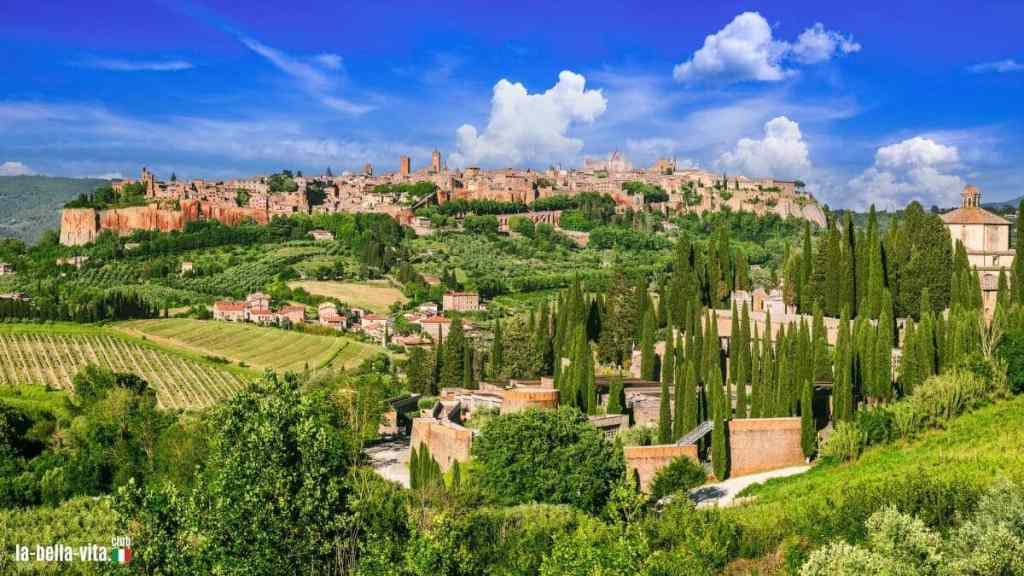
Photo: stock.adobe.com/ecstk22
Orvieto is enthroned on a 300 metre high tuff rock, which was already used as a settlement by the Etruscans. The cathedral, built in 1288, is considered one of the most important buildings of Italian Gothic architecture. The façade was designed by the architect and sculptor Lorenzo Maitani. There are over 1,200 caves carved into the rock beneath the city, which were used as storage rooms and escape routes until the Middle Ages. More history in a very small space is almost impossible.
- Inhabitants: just under 20,000
- Locationin the centre of Italy away from the big cities
- More information about Orvieto (external)
Italy in autumn: 7 regions where wine tastes best now
Lecce in Apulia: baroque heritage in the south

Photo: stock.adobe.com/ mitzo_bs
Lecce grew mainly from the 16th to 18th century through the trade in olive oil and stonemasonry. From the soft limestone, the so-called Pietra Leccesedozens of churches and palaces with the finest ornamentation were built. Among the most important are the Basilica di Santa Croce and the Palazzo dei Celestini. In the evening, people meet in Piazza Sant'Oronzo, where Roman remains and Baroque façades still stand side by side. Today, Lecce is known as the "Florence of the south".
- Inhabitants: a good 90,000
- Locationin the tip of the Italian boot heel
- More information about Lecce (external)
A holiday in Italy begins at the autogrill: the story of a myth
Cividale del Friuli in Friuli-Venezia Giulia: capital of the Lombards

Photo: stock.adobe.com/JackF
Cividale was founded in the 6th century by Alboin, the king of the Lombards, and was their first residence on Italian soil. The old town centre is a UNESCO World Heritage Site. The Tempietto Longobardo contains frescoes from the 8th century. The "Ponte del Diavolo" over the river Natisone dates back to the 15th century and is one of the most famous buildings in Friuli.
- Inhabitantsaround 11,000
- Locationnorth-east, on the border with Slovenia
- More info (external)
Soak up the sun at the last minute: Italy's insider tips for October
Sulmona (Abruzzo) - city of sugared almonds

Photo: stock.adobe.com/Only Fabrizio
Sulmona lies at the foot of the Majella and is known as the home town of Ovid and for its Confetti famous - colourful glazed almonds that have been produced since the 15th century. The local confetti museum documents the history of this craft. Piazza Garibaldi, one of the largest in central Italy, regularly hosts markets and historical parades. The Romanesque church of San Panfilo and the medieval aqueduct characterise the townscape.
- Inhabitantsaround 22,000
- Location: approximately in the centre of the Italian boot
- More info (external)
One of Italy's last insider tips: Abruzzo
Mantua in Lombardy: Renaissance residence

Photo: stock.adobe.com/JooLeeK
Surrounded by three artificial lakes, Mantua was the centre of power of the Gonzaga family in the 15th and 16th centuries and an important centre of the Renaissance. The Palazzo Ducale has around 1,000 rooms, including Mantegna's famous "Camera degli Sposi". The weekly market in Piazza Sordello still sells pumpkin, salami and mostarda from the region - ingredients that also make Mantua unique in culinary terms.
- Inhabitantsaround 50,000
- Location: in the south of Lombardy
- More info (external)