
From our editorial team
The greatest love drama in literature, known the world over: The story of Romeo and Juliet was not an invention of William Shakespeare, but is said to be a partly true story. The first written accounts of the tragedy predate the Englishman's work of the century. Much more adventurous, however, is the origin of the balcony of the "Casa di Giulietta".
The Italian writer Luigi da Porto was probably the first to write about the unhappy couple Romeus and Giulietta, 60 years before Shakespeare, and laid the foundations for Verona's current fame. His "Historia novellamente ritrovata di due nobili amanti", the rediscovered story of two noble lovers, was published in 1530.
In 1554, the poet Matteo Bandello developed the story into the novella "La sfortunata morte di due infelicissimi amanti", the unfortunate death of two unhappy lovers. The English poet Arthur Brooke turned it into the poem "The Tragicall Historye of Romeus and Juliet" in 1562 - the model for Shakespeare's exceptional work, which was published in 1597.

Verona was romance and conflict
Shakespeare retained Verona as the setting for the love tragedy in his work: During the Renaissance, the city was considered both romantic and conflict-ridden. Verona was located in northern Italy, which was known for its constant feuds and rivalries between the rich city states. Verona also had the advantage of sounding exotic to an English audience without being completely unknown. Italy in the 16th century was a centre of art, literature and culture, and Verona was a city with a long history and impressive buildings. For a theatre audience of Shakespeare's time, this offered the perfect blend of wanderlust, romance and drama.
Although the names of the Montagues and Capulets, Montecchi and Cappelletti in Italian, were already mentioned in Dante's "Divine Comedy", there are no concrete historical records to prove that the exact families described by Shakespeare actually existed in Verona. Nevertheless, this literary mention in Dante's work contributed to such family feuds being perceived as authentic.
The thing with Julia's balcony
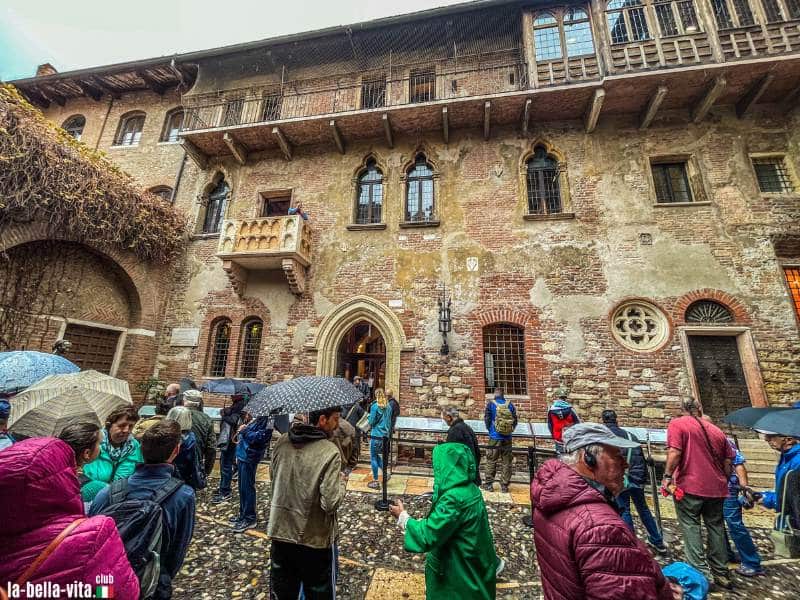
The "Casa di Giulietta", Juliet's house, can be found in every travel guide to Verona today. What is often not mentioned is that the house in question was actually once a stable and not the home of a well-heeled Veronese family. The stable belonged to a family called Dal Cappello in the 12th century - there is a certain similarity to the name "Capulet" from Shakespeare.
As more and more tourists travelled to northern Italy at the beginning of the 20th century and, above all, wanted to see the setting of the world-famous love drama, the locals got tired of explaining why it didn't exist and wanted to offer visitors more. The city of Verona bought the stables in Via Cappello and had them extensively remodelled, including the main hall and gents - and added a balcony. And to this day, almost two million people a year marvel at it. The imagination takes you away when you stand in the courtyard, whether or not it has been extended.
Why Julia brings luck today

The inner courtyard of the Casa di Giuletta, where you can admire the balcony of love, is accessible free of charge. An officially hired "Juliet" usually poses here on the balcony for the many thousands of photos that are taken in a day. The statue of Juliet, created by Italian sculptor Nereo Costantini in 1972, is also located in the inner courtyard. The bronze figure shows Juliet in a pensive, slightly reserved pose. Because touching her right breast is said to bring good luck in love, this area shines as if freshly polished.
It used to be customary to leave a love note in the doorway to the courtyard. Now there are dozens, many more, a few thousand are written on the wall. Mostly a "Ti amo" or an "I love you", or two letters surrounded by a little heart. Even though the city of Verona has banned vows of love for years, some particularly infatuated people seem to carry on.