
Planned on the drawing board: this is what Sabaudia looks like today
From our editorial team
Straight streets, straight houses and straight squares. Sabaudia, almost 100 kilometres south of Rome, looks different to other Italian towns.
Instead of growing for centuries like other Italian cities, Sabaudia was created as part of a major state project under the Italian dictator Benito Mussolini. Planned on the drawing board in 1933, it was inaugurated in 1934. The city was intended to show how the fascist regime envisioned the „new Italy“: clearly organised and functional.
Italy quiz for city travellers - how many places do you recognise?

Planned as a „supply centre“
Sabaudia was not planned as a classic town, but was to serve as an administrative and supply centre for the newly acquired agricultural areas of the Pontine Marshes - with authorities, schools, a market and all other necessary infrastructure. Agricultural settlements were to be built around it, farmed by farming families settled by the state.

The implementation of this concept had limited success. The population grew more slowly than planned and no industry was established. The planned „supply centre“ developed into today's town of Sabaudia.
The 60-second quiz - How quickly can you recognise Italy?
This is what Sabaudia looks like today
The architectural evidence of that time still characterises Sabaudia today. On the central square stands the Palazzo Comunale with the 46 metre high Torre Civica. The building is a simple, rectangular box with narrow, high windows, flanked by the angular tower. In the immediate vicinity are the former party building, the former Casa del Fascio, an angular building with long ribbon windows, and the Santissima Annunziata, a cubic, smooth church building with a free-standing bell tower.

The building materials are repeated throughout the city: smooth façades, light-coloured stone, colours between sand, beige and light grey. The blue post office, the Palazzo delle Poste, is a visual eye-catcher. The smooth façade is covered with blue mosaic tiles.
Knowledge test: Can you do Italy in 60 seconds?
Architecture as an expression of order
Sabaudia was built within 13 months. A young quartet of architects designed the town and the public buildings according to the principles of Italian rationalism, everything following a strict order. Clear lines, simple forms, hardly any jewellery. Visual axes connect central points such as the main square and the Torre Civica.

Sabaudia was made possible by the draining of the Pontine Marshes south of Rome. For centuries, the area was considered almost unusable. Since ancient times, drainage attempts have repeatedly failed. It was not until the 1930s that the state realised the project with great technical and human resources.
Kilometres of sandy beach
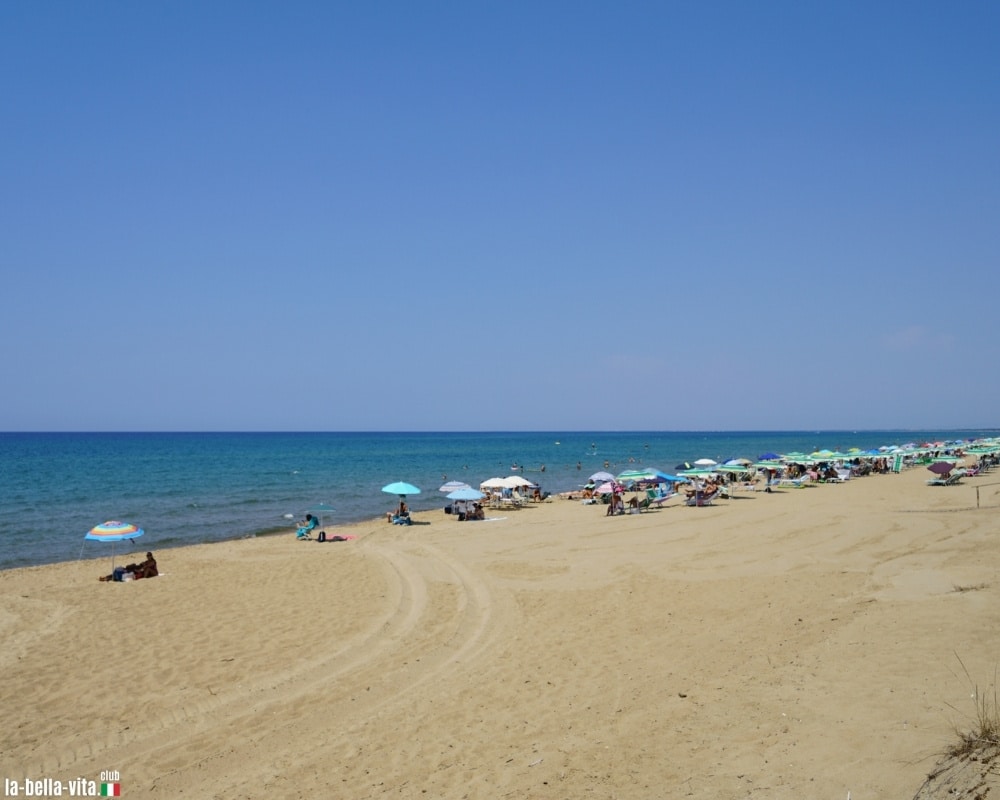
Today, Sabaudia is a popular holiday resort, especially among Romans, with cafés and lidos. The location is exceptional in terms of landscape: Sabaudia is situated between the coast, dunes, lakes and what is now the Circeo National Park. The beach stretches for several kilometres, with lagoons and wooded areas behind the dunes.