
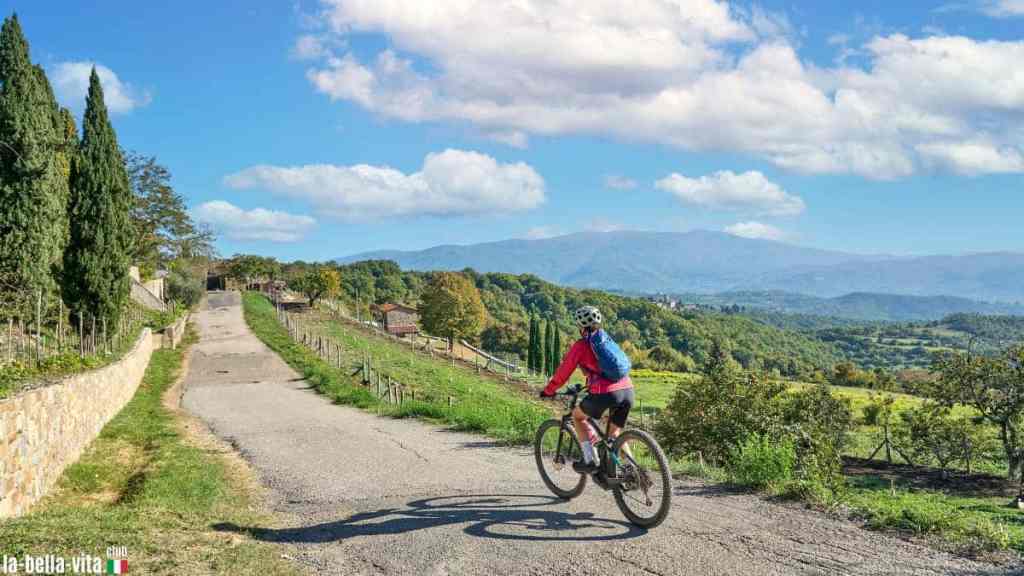
What a panorama! Around Lake Garda on a mountain bike Photo: stock.adobe.com/Val Thoermer
From our editorial team
Until now, when you thought of Italy and two-wheelers, you automatically thought of rattling Vespas. Another form of transport has long since conquered the country: cicloturismo, or cycle tourism, is currently experiencing a hype in Bella Italia.
Cicloturismo stands for environmentally friendly travel that revitalises small villages and remote landscapes while offering a new kind of holiday. More and more people are discovering the beauty of the country from the saddle of a bike, and as the infrastructure grows, cycling in Italy is becoming easier and more attractive.
From niche to billion-dollar market
Just ten years ago, cycling in Italy was mainly a passion of ambitious amateur athletes and racing bike enthusiasts. Today, cicloturismo is one of the fastest growing travel segments in the country. According to a recent study by the environmental organisation Legambiente and the ISNART Institute, over 56.8 million cycle tourism visits were counted in 2023 alone - this corresponds to 6.7 % of all tourist trips in Italy. German cycling holidaymakers, for example, already name Italy as their second favourite destination after Austria.
The development has economic consequences: Over 5.5 billion euros in revenue was generated by cycle tourism in 2023 - and the trend is rising. By comparison, the figure was around half that in 2019. Small, sustainable accommodation, bike hire and local producers in particular are benefiting from this trend: people who travel by bike often travel more consciously, stop more often and spend more on regional specialities and experiences. The increasing demand has led to the development of numerous events and trade fairs centred on cycle tourism. One example is the "Fiera del Cicloturismo", the largest Italian trade fair dedicated exclusively to cycle tourism, which will take place in Bologna from 4 to 6 April 2025.
Why is Cicloturismo so popular?
Cycling holidays are one of the gentlest forms of tourism. They leave no environmental impact from traffic, require hardly any infrastructure and allow travellers to discover Italy in an original way. At the same time, they are often cheaper than conventional holidays, which makes them attractive to many. It is also an intensive way of travelling, where you take the time to experience the country with all your senses.
A cycle tour not only takes you through impressive landscapes, but also into the heart of small villages and towns. You meet people, taste local specialities and literally experience a region with all your senses. In addition, there is the personal challenge of the kilometres pedalled and the feeling of happiness at the end of the day: how could you enjoy a sumptuous Italian meal in the evening with a clearer conscience?

Where is the bicycle boom coming from?
There are many reasons for the cycling boom in Italy. On the one hand, the infrastructure and range of options have improved considerably in recent years. Numerous new cycle paths have been built or extended, including the breathtaking Ciclovia del Sole between Verona and Bologna or the Ciclovia Adriatica, which winds its way along the Italian east coast. There are also more and more bike-friendly hotels and bed & breakfasts that cater specifically for cyclists. Added to this is the e-bike revolution, which makes holidays on bikes a relaxed option for amateur athletes too.
More and more people want to make their holidays active and environmentally friendly, combining nature experiences with sporting activities. Due to the generally extreme heat in summer, spring and autumn are particularly suitable for cycling tours through Italy. The FIAB (Federazione Italiana Ambiente e Bicicletta) has been working for 30 years to ensure that cycling holidays become an integral part of soft tourism: environmentally friendly, decelerated and ideal for experiencing the beauty of Italian landscapes, historic villages and cultural treasures up close.
Another goal of the FIAB is to revitalise rural areas through cycling infrastructure. The planning of new cycle paths helps to make unused routes and regions accessible to tourists and locals by converting old roads, railway lines or nature trails into attractive cycle routes. This makes Cicloturismo a sustainable development tool for rural areas.

More on the subject of Cicloturismo
- To make cycling holidays in Italy even more attractive, the website bicitalia.org was launched. It presents a network of cycle paths that run throughout Italy and are now an official part of national cycle traffic planning.
- The EuroVeloNetwork: Since 2011, FIAB has been coordinating the EuroVelo project in Italy, which aims to ensure a high-quality trans-European cycle route connection from north to south and from west to east. There are currently 17 EuroVelo routes available, with well signposted, safe and comfortable routes.
- Albergabici.it is a platform that lists bike-friendly hotels and guesthouses - with secure bike parking and repair facilities, for example - throughout Italy. Many of these accommodations are located directly on popular cycle routes and offer extras such as guided tours or luggage transport.
- In addition to the FIAB, there are numerous professional tour operators who specialise in cycle tourism - from individual hotel bookings and guided tours to complete packages with luggage transport, rental bikes and technical support.