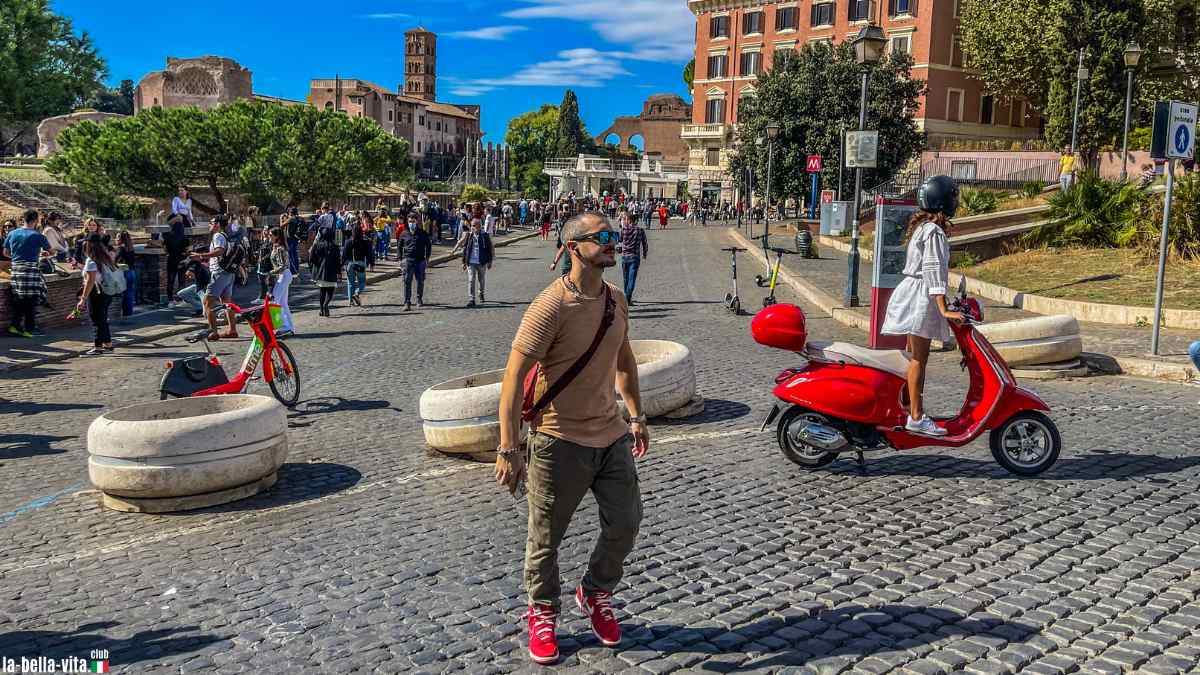
Photo session with Vespa in front of the Colosseum in Rome
From our editorial team
The ultimate feeling of freedom! The warm wind on your skin, the rattling in your ear - and never any problems with parking. Since its birth, the Vespa has not only stood for mobility, but also for an attitude to life - and independence. The whole story.
After the Second World War, Italy lay in ruins. Industry and transport were in ruins and cars were unaffordable for most people. Piaggio, originally an aeroplane manufacturer, was looking for a solution to make people mobile again. Inspired by the US Army's small cargo scooters that whizzed across airfields, Enrico Piaggio commissioned engineer Corradino D'Ascanio to develop a similar vehicle. At the time, nobody could have imagined the extent of the invention.
What made the Vespa so special
Engineer D'Ascanio had no experience with two-wheelers, and that was a stroke of luck in this case. The engineer, known for building the first Italian helicopter, brought a breath of fresh air to the world of scooters. He placed a 3 hp two-stroke engine, which is normally used to start aircraft engines, directly on the rear wheel of a scooter. The handlebars were mounted on the front wheel, which was only suspended from a fork, similar to an aeroplane.
The design was revolutionary: the Vespa was not simply assembled, it was moulded - from robust sheet metal that embodied Italian lightness and elegance. The Vespa was not just a technical masterpiece. It was practical: the wide step-through made it possible to ride comfortably even in dresses or skirts, and the built-in weather protection ensured that you weren't soaked through with every drop of rain.

Photo: Piaggio

Vespa models that made history
The first Vespa, model 98, was presented in 1946 - the Italians were not enthusiastic at first. The new vehicle looked far too round, which was unusual at the time. "It looks like a wasp," Piaggio is said to have exclaimed when he saw the scooter for the first time. And so the "Vespa" was born - named after the Italian word for wasp. The patent was registered on 23 April 1946 and a new chapter in the history of mobility began: What characterises the Vespa to this day is not its design, but the attitude to life it conveys - the feeling that you can conquer the world on two wheels.
The Vespa and Italy fell in love at second sight. Demand increased rapidly. This was followed by countless further developments from Piaggio. The Vespa 125, which came onto the market in 1948, offered more power and was soon replaced by the legendary Vespa 150 GS, which appeared in 1955 and is considered "the most beautiful model of all time". This was followed in the 1960s by the Vespa 50, which was specially developed for young people and could be ridden from the age of 14 without a driving licence, and so on and so forth. And now there is also an electric version.
How the Vespa conquered Hollywood

Photo: Paramount Pictures
To date, more than 20 million Vespas have been sold worldwide. The iconic scooter has appeared in more than 150 Hollywood films: The breakthrough came in 1956 with "A Heart and a Crown" (original title: "A Roman Holiday"). In one of the most famous scenes, Audrey Hepburn rides through the streets of Rome on a Vespa - closely embraced by Gregory Peck. From then on, the Vespa was no longer just a means of transport, but a symbol of freedom, adventure and dolce vita.
Want to find out more about Italy's south - did you know that in Puglia more than 60 million olive trees or that the Naples underground is one of the most spectacular in the world?